
Monday, March 23, 2026
Weka Iti's Compost Monster
Weka Iti have been finding out what makes good compost for our school garden. We learnt that 'compost' is like magic dirt. It turns "yucky" waste into "yummy" food for our school garden! A compost bin is like a "tummy" that needs the right food to stay healthy. To make the best compost we mix a layer of green things and then a layer of brown things and repeat this.
We decided to turn our compost knowledge into a compost monster as a sign for the compost bin in our classroom. This will help us to know what to put in our compost bin in our learning space so that we can then transfer this to our school compost. We are going to invite Trevor, our school caretaker into our class to see if he can help us with helping to give our school compost a tummy that is getting the right food.
We also learnt that there are some foods that are not good for our compost. We have to be careful not to attract "unwanted guests" like mice, rats or possums. These foods are not OK for our compost.... meat or dairy. No leftover ham sandwiches or cheese. No plastic. No glad wrap, chip packets, or fruit stickers and no bread as this can attract pests.
Check out our Compost Monster

Monday, February 23, 2026
Our Fort Care Code
We’ve developed a student-led Fort Care Code to guide our adventures! This helps us keep our fort area a safe, respectful, and exciting place for all students to explore and play together.
The slides show what each Rōpū came up with when discussing their ideas for a fort care code. We then put all our ideas together to come up with a Fort Care Code for everyone. This will be erected as a sign at the entrance to our fort.
Sunday, February 22, 2026
Tiaki Taiao
We are excited to share that we have gifted our Enviroschools programme a new name: Tiaki Taiao – Caring for Nature. This name change reflects our heart for the land here at Kaniere. Tiaki Taiao is an integral part of our school programme because it empowers our tamariki to see themselves as guardians of the earth, ensuring our local environment thrives for generations to come.


Kahlo and the Whio
Our Weka Iti whānau grew a little wiser this week thanks to a very special story shared by Kahlo and her mum about one of our most precious local treasures—the Whio.
Friday, February 20, 2026
Becoming Nature Detectives with Tiaki Taiao
If you want to find a creature, you have to think like one! That’s what we learned on February 18th when Leigh from DOC and Laura from Enviroschools visited our Tiaki Taiao group.
We spent the session learning how to use tracking tunnels to see what animals live around us. To get our "detective eyes" ready, Leigh showed us some real footprints that had been found in tracking tunnels. We had to look closely at the shapes and toe marks to see if we could guess which animals they belonged to!
We found out that tracking tunnels help us see the footprints of the creatures we usually can’t find during the day. We even learned that some animals are "claustrophobic"—they won't go inside if there is only one door! They need an entrance AND an exit to feel safe enough to walk through the ink.
After learning how to bait and position the tunnels, we set one up right by our school garden. We are so excited to take these skills to Lake Kaniere soon to see who is living in this area. Thank you, Leigh and Laura, for helping us become kaitiaki of our environment. We can't wait to share our new knowledge with everyone in our Rōpū!


Monday, August 11, 2025
Rimu Planting


Rimu had an wonderful time planting seedling along the bike track of our lovely kura. We talked about why it is important to grow trees and look after them. We also designed signs for the rimu tree we will plant.
Kōwhai Kaitiaki! - Guardians of the Kōwhai!
This week, Kōwhai, along with other rōpū, planted some of the plants that have been growing strong in our propagation tunnel. We worked together to dig holes and plant them along the fence line and bike track, to build up our beautiful native bush around the kura.
We also spent time in Kererū as a rōpū, creating a draft image and idea for what we want our Kōwhai sign to look like, which will be displayed next to the Kōwhai tree that has been planted. We had specific requirements and outlines, which we used to guide our planning process.
Enjoy a few pictures below from our awesome afternoon!
Our Planning.

Max getting ready to help Jackson dig a hole for his plant.

Lydia and Stella choosing a tipu to plant.

Thursday, August 7, 2025


Thursday, May 22, 2025
Recognising Rubbish
Check out our blog post about what we have been learning about rubbish.
https://kanrm3.edublogs.org/2025/05/23/week-4-enviro-schools/
Thursday, October 31, 2024
Taking Action
We found out that we had a problem in the school, as lots of sycamore trees were popping up in the old playground. We thought that if these stayed here, we wouldn't be able to play on the playground, as it would be filled with trees. We went outside for 10 minutes, and we had to pull 10 plants out. We worked out that it would be 200 plants. We ended up pulling out 1055 plants in 10 minutes. We went out and did another 5 minutes and pulled out around another 700.

Sunday, July 14, 2024
Leaders Action Day at Barrytown
Our Year 6 Leaders joined Barrytown and Hokitika Primary Schools in an Action Day organised by Enviroschools Co-ordinators Lauren and Laura.

Our focus was on Matariki, our trip coincided with the rising of Poaka and the Matariki cluster.
There was a rotation of activities. Robyn, a local landowner, shared her knowledge and family traditions, of Celtic origins, and the Hawthorne bushes that grow on her property. Learning about different cultures and their relationships with the natural world is interesting.

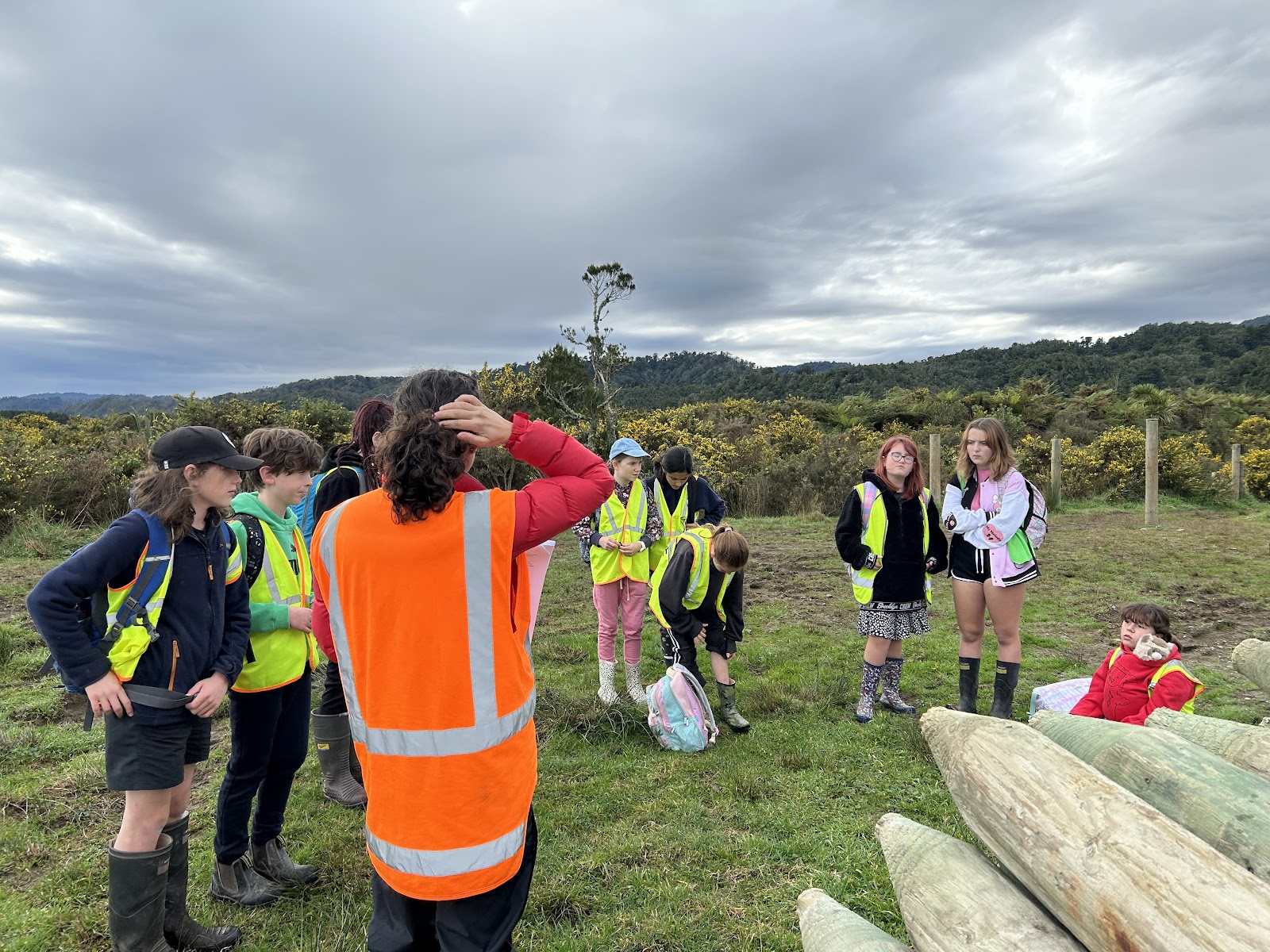
Our first activity was astronomical in nature. It centred around the position of stars within the Matariki cluster and the meaning of the stars. Students nominated a star and came up with an action to represent that star, before getting themselves in a position the star holds within the star cluster.
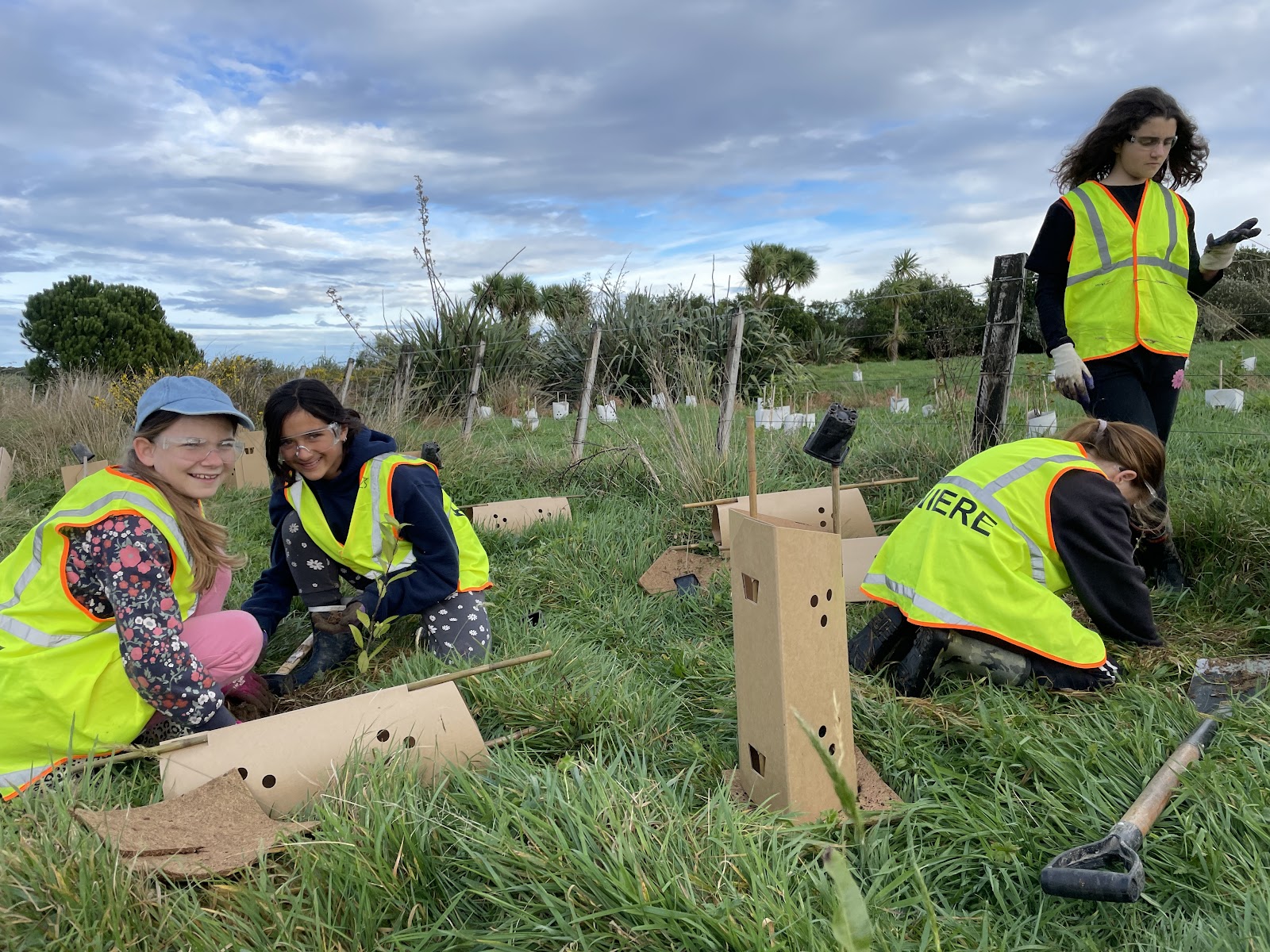
Then it was off to the planting station. Annie and Sarah, from New Zealand Conservation Volunteers, showed us how to correctly plant trees and protect them from marauding weka. The planting connects the existing bush edge with the coastline. This makes a mountain-to-the-sea connection that birds can use to traverse the ecosystems. This is very rare on the Barrytown Flats. The planting is on Robyn's land. It needs to be at least thirty metres wide to support the birds. It takes many thousands of trees to be planted to create the passage. The trees we planted were part of the billion trees planted worldwide to mark the coronation of King Charles III.
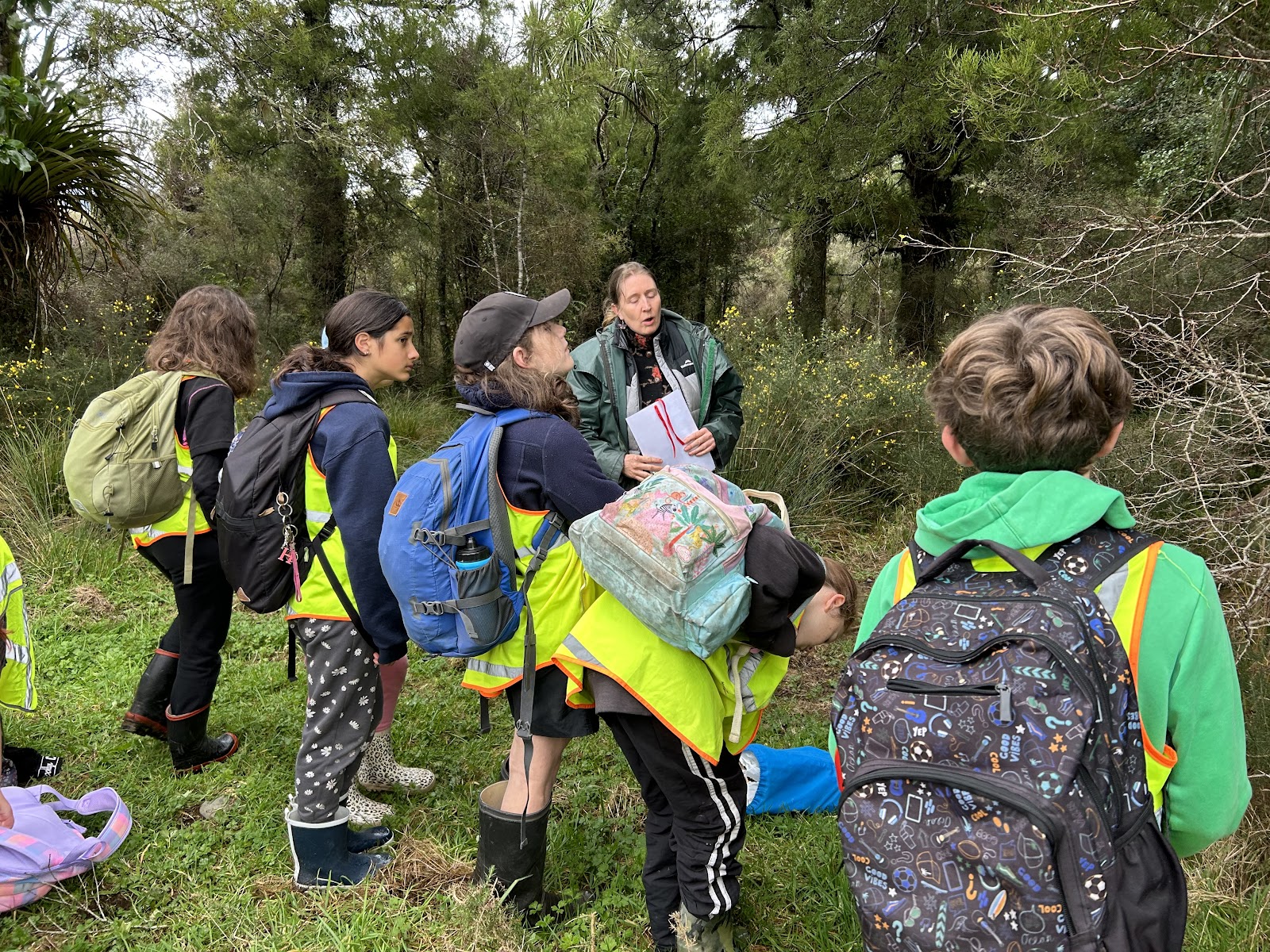
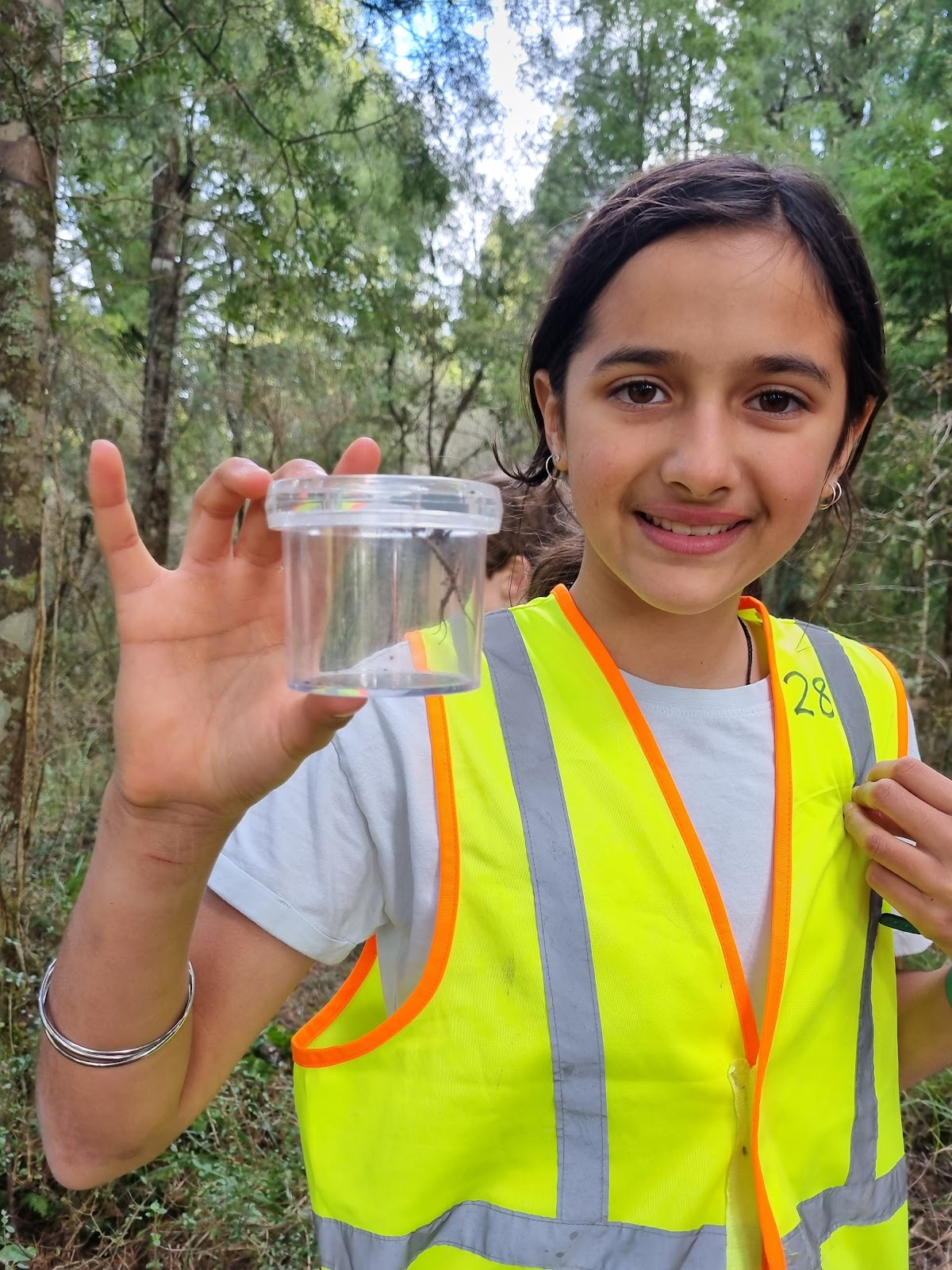
Our last station was hosted by Vanessa from the Department of Conservation. The focus of this station was on the ecosystem present in the Ngahere, the bush. We created a web of life based on local fauna, and then we shook the bushes to find creatures we don't always see as we traverse through the bush. The highlight was a stick insect but huhu's were also in high demand.
Thursday, June 20, 2024
Whole School Activities
It was a bleak day, with a quick shuffle we finished Enviroschool afternoon activities. The activities are led by our wonderful Crusaders. They try to choose activities that appeal to all the age groups at school. This term we focused on the Living Landscape.
The students organised 'Who Am I?'. The person who was in had to try and guess the pest. The audience could only answer yes, sometimes or no to questions. Mrs Scott would have died if she could see what was on her head!

In the room next door we had 'Tricky Tracks' matching the tracking tunnel prints to the animal.


Over in Weka, the 'Human Camera' was snapping away. In pairs one child was the camera the other the camera operator. The camera operator tapped the camera on the shoulder to open the shutter. Then they had to guess what they saw. It was a lot of fun.

As we have a spare classroom we had a game of 'Ants and Anteaters'. After lining up in two lines ants ran left and anteaters right. If the leader called Ants the anteaters chased the ants and if they called anteaters the opposite happened.

It was an awesome afternoon and well done leaders.
Saturday, December 9, 2023
Penguin Nesting Boxes - The final steps
We completed our Penguin Nesting Box project over the last 2 weeks by decorating the boxes and presenting them to Lucy from the West Coast Penguin Trust.
Last week we planned our design for painting the boxes.

We then painted the boxes using only 5 colours, red, yellow, blue, white and black. We were able to make any colour we needed from these 5 colours.


Monday, November 27, 2023
Sensory gardens
Have you heard of a sensory garden? Sensory gardens can help people self regulate when they are feeling low, lacking energy, or high and over excited. We have focused on bring different elements in that appeal to different senses. Each group had to design part of the garden that appealed to our sense of: smell, taste, sound, texture or sight.
One group is in charge of developing a garden to go around a boat that we are having restored to go in the garden.
First we measured the area the garden is going in. Then each group drew a scale map. We then had to research what would be appropriate to have in the garden. As part of our research we went on a virtual tour of a sensory garden in Christchurch. One of our parents walked around the garden with a phone camera talking to us about what was there. We also got to talk to some of the children using the garden.
We found that lots of plants overlapped, that is they fitted with texture and smell, or colour. We discovered that different levels are important in a sensory garden. We saw lots of great ways to introduce different textures with fences, ropes and path surfaces. Lots of people thought water was a good idea in a sensory garden.
After we put all our group's ideas on a shared slide we started making a three dimensional model of our garden. We have shared these with our principal and we need to share it woth our school board as well.
Our next step will be to have some plans drawn up so we can gather our materials, raise some funds and start our garden.


Enviroschools afternoon- Yooshi Game
Yoshi is the story of a turtle who facces obstacles in his journey through the sea. Our leaders Zoe and Isla changed a few details and Yoshi became a blue penguin, or Korora. The leaders set up an obstacle course for students to navigate blindfolded. They had a sighted partner to tell them what to do but they were only allowed to use their voice.
The obstacles included chairs, tables and ropes. Some of the obstacles were a bit tricky. I guess that is true too for the korora, finding your way back to the beach and navigating the sandhills at dawn and dusk must be a challenge.

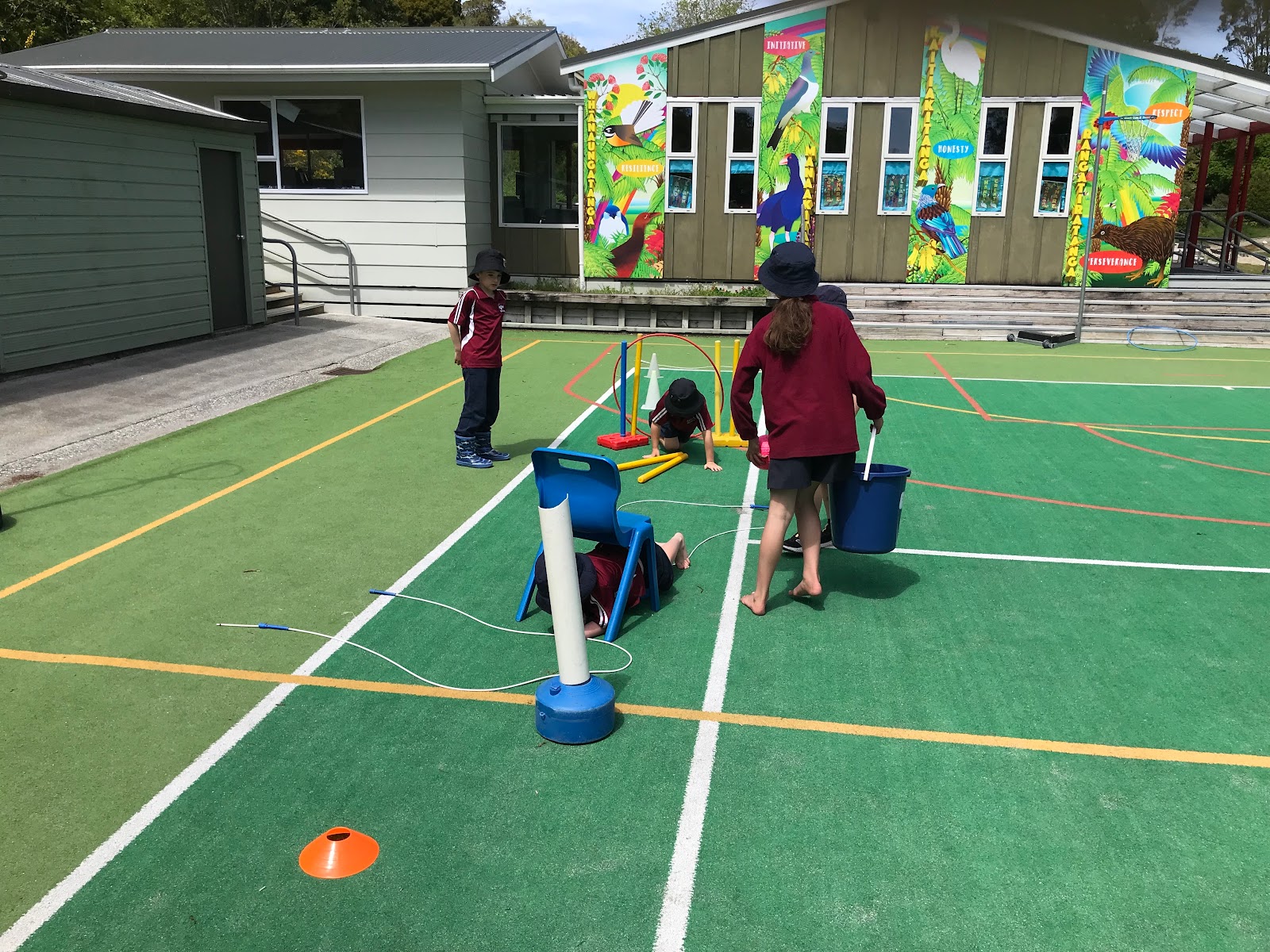

Hoops proved a challenge.
Does your school have Enviroschools activities run by your school leaders?
Friday, November 17, 2023
Habitat Trip
On Thursday 16th November, Rūma Kereru and Rūma Piwakwaka had a field trip to Hokitika beach to learn about Kororā Little Blue Penguin and to Wadeson Island to learn about whitebait habitats.
We all gathered on the beach at the northern end of Hokitika where we met Lucy from the West Coast Penguin Trust. 45 students and 13 adults made a very large group of people!

Our first job as penguin rangers was to look for foot prints on the beach and identify who they belonged to. Tasman really enjoyed looking for tracks. Bede liked learning about the different types of prints and being in the sun.


Next we identified some Kororā prints.
They always go in a pretty straight line from the dunes to the sea.

We made some plaster casts of the footprints we found. For lots of us this was our favourite thing.

After we had had morning tea, we went to Wadeson Island and learnt about whitebait and restoring their habitat with Petra from Westland Milk Products. There are now lots of breeding sites for the whitebait at Wadeson Island.


This is a video Mrs Locky took at low tide a week before our visit. Whitebait are a bit scared by noise and movement so they were difficult to spot on our trip but they are there!
Subscribe to:
Posts (Atom)